
Select Sections to Print
×Book Details
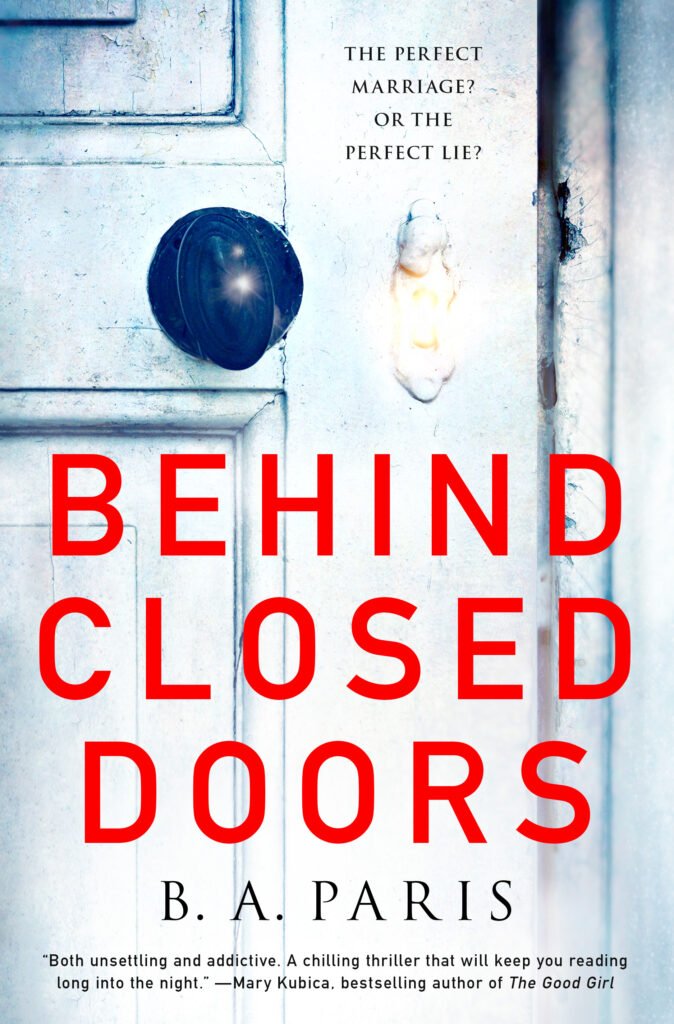
Behind Closed Doors
Jump to Section
⚠️ Trigger Warnings
- Domestic abuse (emotional & psychological)
- Coercive control & manipulation
- Imprisonment / captivity
- Physical violence & assault
- Violence against a person with a disability
- Ableism / targeting vulnerable individuals
- Animal cruelty (death of a pet)
- Starvation / deprivation
- Non-consensual drugging
- Medical gaslighting
- Graphic imagery of injuries
- Death (including dehydration)
- Suicide / overdose references
⏱️ 2-Minute Spoiler Summary
Grace Harrington meets Jack Angel, a charming and successful lawyer, and quickly falls into a whirlwind romance. Jack appears perfect—especially in how he embraces Grace’s close bond with her younger sister, Millie, who has Down syndrome and depends on Grace for care. They marry quickly, but small warning signs begin to surface almost immediately.
During their honeymoon in Thailand, Jack reveals his true nature: he is controlling, manipulative, and derives pleasure from fear. He has orchestrated their marriage to trap Grace, knowing that her devotion to Millie will keep her compliant. Once they return to their home in England, Grace is essentially imprisoned—locked in rooms, deprived of food, and psychologically tortured. Jack maintains a flawless public image, hosting dinner parties where Grace must perform as the perfect wife.
Grace’s greatest fear is for Millie, who is soon to come live with them. Jack plans to subject Millie to the same terror, using a specially prepared basement room. Despite her isolation, Grace searches for a way out. With Millie’s help—who secretly gathers sleeping pills—Grace formulates a plan.
When Jack is vulnerable after losing a court case, Grace drugs him and traps him in the same basement room he intended for Millie. She leaves for a planned trip, creating an alibi. Jack eventually dies of dehydration, mirroring the fate of a puppy he once cruelly killed. The death is ruled a suicide.
With the support of a friend who suspects the truth but chooses to help, Grace and Millie are finally free, able to move on from the ordeal.
📖 Full Spoiler Summary
A Perfect Man in the Park
Grace Harrington meets lawyer Jack Angel on an ordinary day in Regent’s Park, a moment that quickly feels like fate. Jack is attentive, charming, and impossibly composed. What truly wins Grace over, though, is not his looks or career, but the way he steps in to dance with her sister Millie—effortlessly kind, unembarrassed, and protective. Millie, who has Down syndrome, is the center of Grace’s life, and Jack’s ease with her feels like proof of his goodness. Their romance accelerates. Within months, Grace gives up her career at Harrods, convinced she has found not only love, but safety—for both herself and Millie.
The Wedding Fracture
The illusion cracks on the wedding day. Millie falls down a staircase and breaks her leg—an incident dismissed as an accident in the chaos. Grace is torn, but Jack insists they continue with the ceremony and leave for their honeymoon. Already, his control begins to surface: the first subtle coercion, the first moment Grace suppresses her instincts in favor of the life she believes she’s chosen.
The Choice That Seals Her Fate
On the way to the airport, Grace begs to stop at the hospital to see Millie. Jack refuses. He pulls the car over and forces a choice—Millie, or their future together. Under pressure, Grace chooses Jack. It is the last real choice she will make for a long time.
The Honeymoon Reveal
In Thailand, the performance ends. Jack drops the mask and reveals the truth with chilling calm. He is not the man Grace married. He is methodical, sadistic, and obsessed with fear—particularly the kind he can cultivate and control. He admits he orchestrated everything, including the relationship, to gain access to Millie. Grace was never the end goal; she was the means. Millie, with her innocence and dependence, is the perfect victim he intends to terrorize once she comes to live with them.
To prove the extent of his cruelty, Jack reveals there was never a housekeeper waiting at their new home. The puppy he gave Grace as a wedding gift has already been left alone to die—thirsty, trapped, and forgotten. The message is unmistakable: this is what power looks like in his hands.
The House That Isn’t a Home
Back in England, Grace is introduced to their house in Spring Eaton—a place that appears idyllic from the outside. Inside, it is a prison. Doors lock in ways they shouldn’t. Windows don’t open freely. A hidden basement room, painted entirely red, waits beneath the surface. Grace is confined to a small bedroom when Jack is away, monitored, controlled, and deprived.
Jack constructs a public narrative as carefully as he designed the house. To friends, neighbors, and even medical professionals, Grace is fragile, unstable, prone to episodes. Every attempt she makes to signal for help is neutralized before it can take shape. Her reality is rewritten in advance.
Performing Perfection
The only moments Grace is allowed outside her confinement are during the dinner parties Jack insists on hosting. She must cook elaborate meals, present herself flawlessly, and play the role of the perfect wife. These evenings are tightly choreographed performances, but they also offer her fleeting contact with the outside world. She tests small acts of rebellion—hesitations, hints, moments that might draw suspicion—but Jack always remains one step ahead, his version of her already planted in others’ minds.
The Slow Psychological War
As months pass, the power imbalance deepens. Grace is starved, punished, and occasionally forced into the red basement room—a space designed not just for confinement, but for psychological terror. Jack commissions her to paint portraits of battered women, his former legal clients, and hangs them there. The room becomes a gallery of suffering, a rehearsal space for what he plans to inflict on Millie.
Grace’s fear evolves. It is no longer just for herself—it is anticipatory, tied to a future she knows is coming.
Millie Sees the Truth
When Grace and Millie are briefly alone together, the final piece falls into place. Millie reveals that her fall on the wedding day was no accident—Jack pushed her. Unlike the adults around her, Millie has seen through him from the beginning. She names him for what he is: dangerous.
But Millie does more than recognize the threat—she begins to act. Pretending to have trouble sleeping, she collects and hides pills, passing them to Grace in secret. Her plan is simple and direct in its logic: Jack can be stopped.
Building the Only Chance
Grace begins to prepare, not through force, but through patience. She establishes a routine, encouraging Jack to drink whisky with her in the evenings. It is a small shift, but a critical one—something predictable, something she can control.
Time tightens around her. Millie’s eighteenth birthday approaches, bringing with it the moment Jack has been waiting for.
The Breaking Point
The turning point comes unexpectedly. Jack loses his first court case, a blow to his identity and control. For the first time, he is distracted, unguarded. Grace seizes the moment. She crushes the sleeping pills into his drink and watches as the effects begin to take hold.
The confrontation is not dramatic—it is tense, physical, and precariously balanced. But Grace manages to lure him into the basement. Disoriented and slowed, Jack cannot react in time. She locks the door. The same door he designed. The same room he prepared for someone else.
Rewriting the Ending
Grace moves quickly. She removes evidence, restores the house to its careful order, and leaves for Thailand – Jack and Grace’s planned getaway. From there, she constructs a new narrative—calls, messages, concern—all designed to suggest Jack simply never joined her.
Days pass. In England, Jack remains trapped. The mechanism he built ensures there is no escape. His death mirrors the cruelty he once demonstrated: dehydration, isolation, helplessness.
The Final Layer of Truth
When Grace returns, the story holds. Jack’s death is ruled a suicide. But not everyone is fooled. Esther, a neighbor and guest at their dinners, reveals she had long suspected the truth. She offers Grace something more powerful than silence—confirmation. By claiming she saw Jack alive after Grace left, Esther closes the last gap in the timeline, ensuring no suspicion can reach her.
Her reasoning is quiet but precise: Jack once described Millie’s future bedroom as red, when everyone knew her favorite color was yellow. A small inconsistency—but enough.
Freedom, at Last
With Jack gone, the house loses its power. The locks, the rooms, the carefully constructed reality—all of it dissolves. Grace and Millie are no longer trapped inside his design.
What remains is not just survival, but the absence of fear—the one thing Jack valued most, and ultimately, the one thing he could not control.
🔚 Ending Explained
The Final Move
After a year of calculated patience, Grace seizes her only real opportunity when Jack is emotionally destabilized by losing his first court case. That night, she follows through on the plan she and Millie quietly set in motion—crushing the sleeping pills Millie has been hoarding and slipping them into Jack’s whisky.
As the drugs take effect, Jack becomes disoriented but not fully incapacitated. What follows is tense and physical rather than dramatic—Grace has only seconds where she holds the advantage. She maneuvers him into the basement, the same soundproof, red-painted room he designed as a future prison for Millie. When he stumbles inside, she locks the door.
This time, the system works against him.
Grace doesn’t linger. She cleans meticulously—removing the second glass, any residue, any trace that could suggest interference. Then she leaves for Thailand as planned, transforming her escape into a performance. She calls, leaves worried messages, contacts colleagues—carefully constructing the image of a confused wife whose husband never arrived.
Back in England, Jack remains trapped. The pills don’t kill him. Instead, he dies slowly, over several days, of dehydration—mirroring the cruel fate he once inflicted on the puppy.
The Discovery
Eventually, concern leads authorities to the house. They break in and find Jack’s body in the basement. Given his recent professional humiliation and the locked-room circumstances, his death is ruled a suicide. The narrative Jack built around himself—control, perfection, reputation—now seals his fate in a different way.
The Final Twist
When Grace returns, she expects relief—but not understanding. Instead, she’s met by Esther.
Esther reveals she has long suspected the truth. Not through dramatic evidence, but through a single inconsistency: Jack once described Millie’s future bedroom as red, despite Millie’s well-known love of yellow. It was a small detail, but it exposed something fundamental—Jack didn’t truly see Millie as a person.
Esther makes a decision. She tells police she saw Jack alive after Grace left for the airport, waving goodbye from the house. It’s a lie—but a precise one. It closes the timeline, removes any suspicion from Grace, and ensures the case cannot be reopened.
Grace is free. Not just physically—but legally.
Thematic Breakdown of the Ending
Symbolism: Red vs. Yellow
The novel’s central symbolic conflict is distilled into color.
- Red represents Jack—control, violence, fear, and the artificial environment he constructs to dominate others. The basement room, saturated in red and filled with disturbing imagery, is the physical embodiment of his psyche.
- Yellow represents Millie—warmth, innocence, individuality, and truth.
Jack’s downfall hinges on his inability to understand this distinction. He reduces Millie to a victim archetype, failing to grasp her identity. That miscalculation—exposed through something as simple as her favorite color—becomes the thread that unravels him.
Character Decisions: Survival Over Morality
Grace’s final act is not impulsive—it’s deliberate, patient, and morally complex. She transitions from endurance to action, accepting the burden of killing Jack as the only viable path to protect Millie.
Her choice reframes the narrative:
- She is no longer reacting to Jack’s control.
- She is orchestrating the outcome.
Esther’s decision mirrors this shift. By lying to the police, she acknowledges that traditional systems—law, reputation, appearances—were tools Jack manipulated. Her act of perjury becomes an act of correction rather than corruption.
Together, their choices form a quiet but powerful alliance.
Tone Shift: From Claustrophobia to Control
For most of the novel, the tone is suffocating—tight spaces, controlled movements, constant surveillance. In the final act, that tension sharpens into something colder and more precise.
Grace’s escape is not chaotic—it is clinical.
By the end, the tone settles into something unsettling: relief, but not peace. Freedom, but not lightness. The horror has ended, but it hasn’t disappeared.
Core Themes: The Perfect Lie
The novel ultimately dismantles the idea of the “perfect marriage.”
Everything Jack builds—his career, his home, his reputation—is a façade designed to control perception. Ironically, those same tools become the foundation of his undoing:
- His spotless legal record explains his “suicide.”
- His carefully constructed house becomes his prison.
- His narrative of Grace as fragile prevents deeper scrutiny.
The system he mastered is the system that traps him.
Future Implications: Freedom with Scars
Grace and Millie are finally safe. The immediate threat is gone, and the future they once imagined is now possible again.
But the ending doesn’t suggest complete closure.
Grace’s awareness lingers—her instinct to watch, to anticipate danger, to remain alert. The physical prison is gone, but the psychological imprint remains. The experience has reshaped her permanently.
Freedom, in this case, is real—but it isn’t simple.
👤 Characters & Fates
🔶 Main Characters




🔷 Supporting Characters

🕳️ Potential Plot Holes
1. Digital Forensics vs. the Alibi
What happens:
Grace builds her alibi from Thailand by repeatedly calling and leaving voicemails for Jack while he is already trapped in the house.
Why it’s questionable:
Modern investigations often include cell tower data, phone usage logs, and device activity. Jack’s phone would show:
- No movement from the house
- No outgoing calls or attempts to seek help
This should have raised questions.
2. The “Red Room” Construction Problem
What happens:
Jack has a hidden, soundproof basement room with a steel door that locks from the outside and no internal handle.
Why it’s questionable:
A structure like this would almost certainly require:
- Contractors or specialists
- Permits or material purchases
- Structural modifications to the home
That creates a paper trail—or at least witnesses. It’s unlikely a high-profile lawyer could build something this extreme:
- Completely alone
- Without neighbors, workers, or inspectors noticing
In a real investigation, this room would likely trigger serious scrutiny, not be treated as just an odd feature.
3. Medical Credibility and Oversight
What happens:
Jack convinces a doctor that Grace is mentally unstable using limited past evidence and controlled narratives.
Why it’s questionable:
A real physician would typically:
- Require direct evaluation of Grace
- Review verified medical history, not secondhand claims
- Be cautious about dismissing claims of abuse or captivity
Instead, the doctor accepts Jack’s version with minimal resistance. This creates a gap in realism, especially given how serious Grace’s claims would be if voiced.
4. Time of Death vs. Esther’s Alibi
What happens:
Esther claims she saw Jack alive after Grace left for Thailand, helping secure Grace’s innocence.
Why it’s questionable:
Jack dies days later from dehydration, not immediately. Forensic analysis can often estimate:
- A general time-of-death window
- Duration of dehydration or starvation
This creates a mismatch:
- Esther places Jack alive at a specific time
- Forensics would suggest he was trapped and dying for several days afterward
The alibi helps, but it doesn’t fully explain how he ended up locked away for days while Grace was abroad.
5. Grace’s Sudden Social Disappearance
What happens:
Grace leaves behind a high-profile career at Harrods and quickly becomes isolated within Jack’s controlled social circle.
Why it’s questionable:
Someone with:
- A demanding international career
- Professional colleagues and contacts
…would likely have people who:
- Check in
- Notice her abrupt disappearance
- Question her sudden lifestyle shift
The lack of outside interference or concern feels like a narrative convenience that helps maintain Jack’s control.
6. Millie’s Fall at the Wedding
What happens:
Jack pushes Millie down a staircase at a crowded registry office, and it’s accepted as an accident.
Why it’s questionable:
The setting is described as busy, with people nearby. Yet:
- No one sees the push
- No suspicion is raised
- Jack avoids scrutiny despite being right beside her
In reality, an incident involving a vulnerable person in a public space would likely attract closer attention or witness accounts.
7. Jack’s Risk Tolerance
What happens:
Jack commits multiple high-risk acts—kidnapping, imprisonment, psychological torture—while maintaining a spotless public life.
Why it’s questionable:
Even highly controlled individuals make mistakes under pressure. Yet Jack:
- Sustains this double life for an extended period
- Avoids detection across multiple systems (legal, medical, social)
The scale of deception requires near-perfect execution, which can feel slightly implausible given the number of moving parts.
Overall Takeaway
Most of these aren’t outright contradictions—they’re plausibility gaps. The story prioritizes:
- Psychological tension
- Control dynamics
- Narrative payoff
…over strict procedural realism. The result is a gripping thriller, but one that occasionally relies on systems (law enforcement, medicine, construction, social networks) behaving more conveniently than they likely would in reality.
📚 Book Club Q&A's
⭐ Final Rating & Thoughts
Behind Closed Doors is one of those thrillers that completely hijacks your attention and refuses to let go. It’s fast, claustrophobic, and deeply unsettling in a way that doesn’t rely on gore—it’s all about control, manipulation, and that creeping realization that something is very, very wrong behind the scenes.
Grace is incredibly easy to root for, especially once the full scope of her situation becomes clear. Watching her shift from survival mode into calculated action is where the story really hits its stride. And yes—the ending is so satisfying. Jack getting trapped in his own twisted setup and dying the same slow, helpless death he inflicted on that poor puppy? That’s the kind of poetic justice that makes you want to stand up and clap.
It’s not a perfect book—there are definitely a few “wait… would that actually work?” moments—but honestly? The pacing and tension are so strong you barely care. This is pure, addictive, domestic thriller energy.
Bottom line: gripping, disturbing, and wildly bingeable. Just maybe don’t read it right before bed… unless you’re in the mood to side-eye your spouse a little.
✨ Adaptation description
A film adaptation of Behind Closed Doors is currently in development, bringing the bestselling 2016 psychological thriller to the screen. The project is being produced by Clear Pictures Entertainment, with Elizabeth Fowler attached as producer. The screenplay is written by Melissa London Hilfers, adapting the novel’s story of a seemingly perfect marriage that conceals a deeply disturbing and abusive reality. The film has been in development for several years, originally announced around 2017 with involvement from Stone Village Productions and producers Scott Steindorff and Dylan Russell, alongside Scott Delman of Shadowfox Productions. Wild Bunch Germany has also been linked to the project. While an official release date has not yet been confirmed, reports have indicated plans for production to move forward around 2024, signaling continued momentum for the long-anticipated adaptation.
✨ Books Like Behind Closed Doors
See an error on this page?