
Select Sections to Print
×Book Details
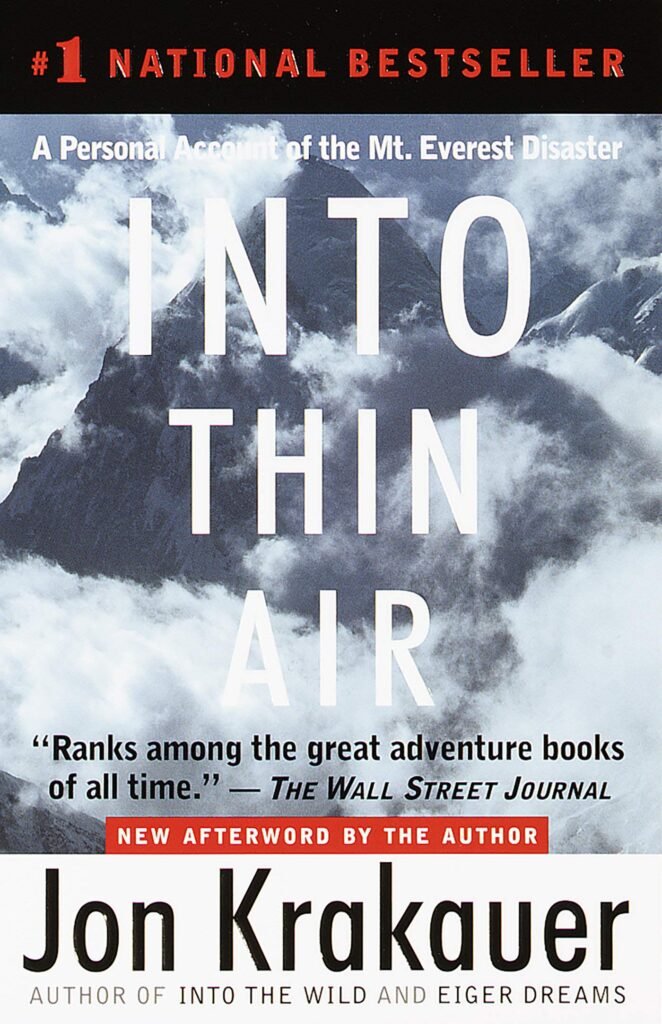
Into Thin Air: A Personal Account of the Mt. Everest Disaster
Jump to Section
⚠️ Trigger Warnings
- Death
- Dead bodies / human remains
- Graphic injury & medical trauma
- Illness (including respiratory distress)
- Extreme environmental exposure (cold, altitude)
- Amputation / loss of limbs
- Psychological trauma / survivor’s guilt
- Grief / bereavement
- Triage / abandonment themes
- Substance use (alcohol, drugs)
- Harassment / verbal threats
- Sexual harassment (brief mention)
- Animal cruelty
⏱️ 2-Minute Spoiler Summary
Jon Krakauer joins a guided Everest expedition led by Rob Hall, originally just to write about the commercialization of climbing. His team, Adventure Consultants, includes several inexperienced but determined clients, like Doug Hansen, alongside other guided groups such as Scott Fischer’s team.
After weeks of acclimatizing between Base Camp and higher camps, the climbers attempt the summit in May 1996. Things start going wrong almost immediately: delays from overcrowding, inexperienced climbers moving too slowly, and guides failing to set fixed ropes on time. Crucially, Hall sets a strict 2:00 p.m. turnaround time—but fatally ignores it. Krakauer summits, but many others, including Hall and Hansen, reach the top dangerously late.
As they descend, a brutal storm hits. Visibility vanishes, oxygen runs low, and climbers become disoriented. Several get lost high on the mountain. Hall refuses to abandon Hansen, who is too exhausted to descend, and both ultimately die on the mountain. Andy Harris dies attempting to help them after becoming disoriented himself.
Meanwhile, Fischer collapses during the descent and is left behind; he also dies. In another group, climbers wander into the storm and nearly perish before a risky rescue effort brings some of them back. One of the most shocking survivals comes from Beck Weathers, who is left for dead twice but somehow staggers back to camp with catastrophic frostbite, eventually losing parts of his hands, feet, and face.
Krakauer makes it down alive but is left haunted by everything that went wrong—the ignored turnaround time, poor decision-making, and the deadly consequences of commercializing Everest. In total, 12 people die during the disaster. The book ends with Krakauer grappling with survivor’s guilt, questioning his own choices, and trying to piece together the full truth of what happened in one of Everest’s deadliest seasons.
📖 Full Spoiler Summary
The Assignment That Turned Deadly
Journalist Jon Krakauer travels to Everest in 1996 to write about the booming commercialization of the mountain—where wealthy clients can pay tens of thousands of dollars for a guided summit attempt. He joins Adventure Consultants, led by veteran guide Rob Hall, whose reputation for safety is among the best in the business.
From the start, Krakauer notices a troubling dynamic: many clients lack the experience needed for such an extreme climb but rely heavily on guides and Sherpas to compensate. The group includes determined but underprepared climbers, like Doug Hansen, who is desperate to summit after failing the previous year.
The team spends weeks acclimatizing—moving between Base Camp and higher camps to adjust to the altitude. Even at this stage, warning signs appear:
- Severe altitude sickness strikes climbers like Ngawang Topche and Dale Kruse
- Competition and tension grow between expeditions, especially with Scott Fischer’s Mountain Madness team
- The sheer number of climbers on the mountain hints at dangerous overcrowding
Still, the summit push moves forward as the narrow spring weather window begins to close.
Summit Push: May 9–10, 1996
The climbers leave Camp Four (South Col) late on May 9, aiming to reach the summit by midday on May 10. Hall sets a strict 2:00 p.m. turnaround time—a critical safety rule meant to ensure descent before nightfall.
But almost everything goes wrong.
- Fixed ropes are not set in advance, causing major delays
- A bottleneck forms at the Hillary Step, forcing climbers to wait in freezing, oxygen-starved conditions
- Clients move slowly, burning through their limited oxygen supply
Krakauer reaches the summit at 1:12 p.m.—just within the safe window—but is already impaired by altitude and low oxygen. He descends quickly, sensing danger.
Behind him, the situation deteriorates:
- Hall stays behind to help Hansen, who is struggling and moving far too slowly
- Fischer reaches the summit dangerously late (around 3:40 p.m.), already exhausted and ill
- The turnaround time is effectively ignored, sealing the fate of many climbers still ascending far too late in the day
This is the pivotal mistake—the moment when a difficult climb becomes a catastrophe.
The Storm and the Collapse of Order
As climbers descend, a sudden, violent storm engulfs the mountain. Visibility drops to near zero, winds become hurricane-force, and temperatures plummet. In the “Death Zone” above 25,000 feet, even small mistakes turn fatal.
The expedition fractures into chaos:
Hall and Hansen
High on the mountain, Hansen collapses, likely out of oxygen. Hall refuses to abandon him—a decision that defines his character but dooms them both. Despite desperate radio calls and rescue attempts, Hall becomes stranded near the summit. He survives through the night, even speaking to his pregnant wife via radio, but ultimately dies after two days exposed.
Andy Harris
Guide Andy Harris attempts to bring oxygen to Hall and Hansen but becomes disoriented in the storm and disappears. Krakauer later realizes, with crushing guilt, that he mistakenly believed Harris had made it back safely—when in reality, he had died on the mountain.
Scott Fischer
Fischer, already severely weakened, collapses during descent. Despite efforts to help him, he cannot continue and is left behind, later found dead.
The Lost Group and Miraculous Survival
A separate group of climbers becomes lost in the blizzard near the South Col, wandering aimlessly in the dark. Several collapse in the snow, seemingly beyond saving.
Guide Anatoli Boukreev makes a controversial but ultimately heroic decision: after descending ahead of clients earlier in the day, he regains strength and ventures back out into the storm multiple times, rescuing stranded climbers one by one.
Still, not everyone survives:
- Yasuko Namba succumbs to exposure
- Beck Weathers is left for dead twice
Weathers’ story becomes one of the most shocking twists in the book. After being abandoned as lifeless, he miraculously regains consciousness hours later and walks himself back to camp in a near-frozen state. Though he survives, he suffers catastrophic frostbite, ultimately losing parts of his hands, feet, and face.
Aftermath: Death Toll and Emotional Fallout
By the end of the disaster, 12 climbers are dead, making it the deadliest Everest season at the time.
Krakauer survives—but not unchanged.
He is consumed by:
- Survivor’s guilt, especially over Andy Harris
- Doubts about his own decisions and perceptions during the storm
- A growing belief that the tragedy was preventable
Controversy and Reflection
Krakauer scrutinizes what went wrong, resisting the idea that the storm alone caused the disaster. Instead, he argues it was a chain reaction of human errors:
- Ignoring the 2:00 p.m. turnaround time
- Allowing inexperienced climbers to attempt Everest
- Overcrowding from commercial expeditions
- Miscommunication and poor coordination between teams
He also addresses the controversy surrounding Anatoli Boukreev—criticizing his choice to climb without supplemental oxygen and descend ahead of clients, while still acknowledging that Boukreev’s daring rescues saved multiple lives.
The Ending: Trauma and the Search for Truth
Krakauer returns home deeply shaken. His original magazine article cannot capture the full scope of what happened, prompting him to write Into Thin Air as a more complete account.
The book ends not with closure, but with lingering uncertainty. Krakauer openly questions his own memory and reliability, acknowledging that in such extreme conditions, even eyewitness accounts can be flawed.
Ultimately, Into Thin Air becomes more than a survival story—it’s an examination of human ambition, ethical responsibility, and how a series of small, seemingly manageable decisions can spiral into irreversible tragedy at the highest point on Earth.
🔚 Ending Explained
A Somber, Unresolved Conclusion
The ending of Into Thin Air is striking because it refuses any sense of victory. Instead of triumph, Krakauer leaves readers with grief, ambiguity, and lingering moral unease. The survivors return from Everest not as heroes, but as people carrying emotional weight that doesn’t fade once they’re off the mountain.
Krakauer himself describes a kind of emotional numbness—he functions, reports, and recounts events, but internally he’s grappling with trauma that doesn’t resolve neatly. The tone is quiet, reflective, and heavy with regret.
The Hardest Choice: Triage and Abandonment
At the heart of the ending is one of the most morally devastating moments: the decision to leave climbers behind.
When rescuers find Beck Weathers and Yasuko Namba near death, they face an impossible calculation. With limited oxygen, strength, and time, they choose to prioritize those who still have a realistic chance of survival. This “classic act of triage” is logically sound—but emotionally devastating.
- Namba dies on the mountain
- Weathers is left for dead (twice)… and then miraculously survives
Even though Krakauer and others later agree the decision was necessary, it leaves a permanent psychological scar. The ending makes clear: doing the “right” thing doesn’t mean feeling at peace with it.
Key Decisions That Led to the Tragedy
Krakauer revisits several critical choices, not to assign simple blame, but to show how small decisions compounded into disaster:
- Rob Hall’s loyalty to Doug Hansen
Hall refuses to abandon Doug Hansen, pushing past the safe turnaround time. It’s an act of compassion—but also a fatal lapse in judgment influenced by pressure, pride, and possibly oxygen deprivation. - Anatoli Boukreev’s controversial descent
Krakauer critiques Boukreev for descending ahead of clients without supplemental oxygen, arguing it limited his ability to help during the initial crisis. Yet he also acknowledges Boukreev’s extraordinary bravery in returning to rescue stranded climbers—complicating any clear judgment. - Krakauer’s own mistake
Perhaps the most haunting thread: Krakauer mistakenly believes Andy Harris made it back to camp. In reality, Harris had died. Krakauer later recognizes he failed to grasp Harris’s impaired mental state, and this error becomes central to his survivor’s guilt.
Symbolism: What the Mountain Represents
The ending layers meaning onto the physical setting, turning Everest into something larger than a location:
- Sagarmatha (the “Mother Goddess”)
The mountain is portrayed as indifferent and overwhelming—a force that doesn’t care about human ambition. The disaster underscores how fragile humans are against nature. - The “stain” of survival
Krakauer repeatedly suggests that surviving comes with a kind of permanent mark. The guilt, the second-guessing, the memories—these don’t disappear. - Discarded oxygen canisters
The debris scattered across the mountain becomes a powerful image of commercialization. Everest is no longer just a remote, sacred peak—it’s crowded, commodified, and treated almost like a managed expedition route.
Core Themes in the Ending
The final chapters sharpen the book’s biggest ideas:
- Hubris vs. Nature
Wealth and ambition allowed relatively inexperienced climbers to attempt Everest, but no amount of money or guidance can fully control the mountain. The disaster becomes a brutal reminder that nature sets the terms. - Survivor’s Guilt
Krakauer cannot fully reconcile his survival. While some climbers find peace, he remains stuck in self-reproach—especially regarding Andy Harris. - Unreliability of Memory
Oxygen deprivation, exhaustion, and trauma distort perception. The ending openly questions whether any single account—including Krakauer’s—is completely accurate.
The Final Message: This Will Happen Again
One of the most unsettling aspects of the ending is its lack of closure or prevention.
Krakauer makes it clear:
- The tragedy wasn’t a freak accident—it was predictable
- The same conditions (crowding, inexperience, commercial pressure) still exist
- Deaths continued even shortly after the 1996 disaster
Despite everything, climbers keep coming. The allure of Everest—status, achievement, personal validation—remains stronger than the cautionary tale.
Bottom Line of the Ending
The ending of Into Thin Air isn’t about solving the disaster—it’s about living with it.
Krakauer closes on the idea that:
- Some decisions were necessary but still morally painful
- Some mistakes can never be undone
- And some experiences leave a permanent psychological imprint
It’s less a conclusion and more a reckoning—one that lingers long after the final page.
👤 Characters & Fates
🔶 Main Characters

🔷 Supporting Characters
🕳️ Potential Plot Holes
📚 Book Club Q&A's
⭐ Final Rating & Thoughts
Into Thin Air is one of those rare books that sticks with you long after you finish it. It’s not just about Everest—it’s about how quickly control slips away when humans push too far. The storm, the ignored turnaround time, the impossible choices… it all builds into something that feels both inevitable and devastating.
What hit me hardest wasn’t just the deaths—it was the aftermath. The guilt, the second-guessing, the fact that even the “right” decisions (like leaving climbers behind) still feel unbearable. And Beck Weathers walking back from the dead? Absolutely unreal.
Bottom line: gripping, haunting, and deeply human. It doesn’t glorify survival—it questions it.
✨ Adaptation description
- Into Thin Air: Death on Everest (1997) — a quick-turn TV dramatization released the same year as the book (rights were purchased prior to book release)
- Everest (2015) — a big-budget, ensemble retelling of the 1996 disaster, not based on the book
🧭 Big Picture Difference
Krakauer’s book is intimate, analytical, and emotionally raw, centered on his personal experience, guilt, and the complex chain of human errors.
The adaptations, especially the 1997 TV movie, are more straightforward and dramatized, focusing on action, survival, and visual storytelling rather than deep reflection.
🔍 Key Differences
Narrative Style
- The book is first-person and subjective, often reflecting confusion and distorted perception due to altitude and trauma.
- Both films present a more linear, third-person narrative, making events clearer but less psychologically complex.
Focus & Tone
- The book emphasizes decision-making, ethics, and systemic failure (commercialization, overcrowding, leadership choices).
- The films prioritize physical danger and emotional drama—storms, rescues, and survival moments take center stage.
Portrayal of Real People
- Krakauer’s account is nuanced and sometimes critical—especially of figures like Anatoli Boukreev.
- The adaptations tend to simplify or soften portrayals, often presenting clearer heroes and less ambiguity.
- Krakauer himself has said the 2015 film’s depiction of him was inaccurate and frustrating.
Accuracy & Controversy
- The book is a firsthand account, but even Krakauer admits memory at high altitude is unreliable.
- Competing perspectives exist—most notably The Climb written by Anatoli Boukreev, which challenges Krakauer’s version of events.
- The films smooth over these conflicts, presenting a more unified (but less debated) narrative.
⚖️ Bottom Line
- The book = layered, introspective, morally complex, and sometimes uncomfortable
- The adaptations = accessible, emotional, and visually gripping—but simplified
If you want the full ethical and psychological weight of the disaster, the book is unmatched.
If you want to see the chaos and scale on-screen, the films deliver—but with less nuance.
✨ Books Like Into Thin Air: A Personal Account of the Mt. Everest Disaster
See an error on this page?