
Select Sections to Print
×Book Details
Station Eleven
Jump to Section
⚠️ Trigger Warnings
●Global Pandemic / Mass Death
●Suicide (on-page, referenced, and implied)
●Violence and Physical Harm
●Cult / Religious Extremism
●Child Endangerment
●Parental Abandonment
●Ableism (verbal references and attitudes)
●Emotional Distress and Trauma
●Gun Violence
●Fatal Illness
●Grief and Loss
●Societal Collapse / Disaster Imagery
⏱️ 2-Minute Spoiler Summary
Station Eleven — Quick Spoiler Summary
A deadly flu wipes out almost everyone in days.
Famous actor Arthur Leander dies onstage the same night the world collapses.
Twenty years later, Kirsten performs with the Traveling Symphony while carrying two rare Dr. Eleven comics Arthur once gave her. A violent cult led by the Prophet terrorizes the region — and he turns out to be Tyler, Arthur’s son who grew up in the apocalypse.
The Prophet tries to kill Kirsten but is shot by one of his own young followers, who then kills himself.
Meanwhile, Arthur’s friend Clark runs the Museum of Civilization in a repurposed airport, unknowingly preserving the world that once defined them all.
The book ends with the Symphony spotting electric lights in the distance, hinting that someone, somewhere, might be rebuilding the world.
📖 Full Spoiler Summary
Station Eleven unfolds across two major timelines — the final hours before the world collapses from the Georgia Flu and the lives of the survivors twenty years later — all tied together by their connection to one man: actor Arthur Leander.
I. Year Zero — The Collapse Begins
Arthur Leander’s Final Night
Fifty-one-year-old actor Arthur Leander is in the middle of playing King Lear at the Elgin Theatre in Toronto when he collapses onstage. He has been stumbling over his lines and looks disoriented; flowers are tangled in his hair as part of the costume.
Former paparazzo Jeevan Chaudhary, who has recently started paramedic training, leaps from his seat and rushes to administer CPR. A cardiologist in the audience joins him, but Arthur is pronounced dead at 9:14 p.m.
A young actress in the production, Kirsten Raymonde (seven or eight years old), watches the entire thing unfold. Jeevan walks her backstage, tries to comfort her, and hears her say she loves acting more than anything in the world. Kirsten is later handed a glass paperweight by her minder, Tanya — an object she will keep for decades.
Arthur’s sudden death — dramatic as it is — turns out to be the beginning of something much bigger.
The Georgia Flu Hits
Moments after Jeevan leaves the theater, he receives a call that changes everything: his friend Hua, a doctor at Toronto General Hospital, tells him that a flight from Moscow has brought in passengers infected with the Georgia Flu, a fast-moving, highly contagious virus with an almost 100% fatality rate.
Hua urges him to get out of the city or barricade himself somewhere safe.
This illness, Hua says, will be the line between “a before and an after.”
Jeevan grabs seven shopping carts of supplies from a grocery store — water, canned food, medicine — and drags it all to the 22nd-floor apartment of his older brother Frank, a paraplegic journalist.
Within days:
- The news collapses
- Hospitals overflow
- The internet dies
- Electricity fails
- Cities go silent
Civilization ends with terrifying speed.
Jeevan and Frank
Jeevan and Frank survive 58 days in the tower together as the city below goes dark.
On Day 58, Jeevan discovers that Frank has died by suicide, leaving behind a note.
Heartbroken but determined to live, Jeevan packs supplies and begins walking south along the lakeshore — avoiding roads and towns, which he knows are now dangerous.
Miranda Carroll’s Final Hours
Meanwhile, Arthur’s first wife Miranda Carroll — a shipping executive and the creator of the Station Eleven graphic novels — is on business in Malaysia. She is informed of Arthur’s death by his closest friend, Clark Thompson.
Miranda begins to feel flu symptoms shortly afterward. As airports close and the world shuts down around her, she wanders onto a beach. She collapses peacefully, knowing she will not survive.
Her comic, Station Eleven, becomes an emotional anchor for two characters who end up carrying it across the new world.
The Stranded Plane at Severn City Airport
Arthur’s best friend Clark Thompson, Arthur’s second wife Elizabeth Colton, and her son Tyler Leander are all on a flight headed to Toronto for Arthur’s funeral.
The plane is diverted as the pandemic spreads. It lands in the small Severn City Airport in Michigan, where passengers quickly realize that no rescue is coming.
They form a settlement inside the terminal — one of the safest, most functional survivor communities in North America.
Clark eventually turns part of the airport into the Museum of Civilization, filled with relics of the old world: laptops, phones, credit cards, a motorcycle, makeup compacts, a laptop filled with Clark’s old corporate files.
After two years, Elizabeth and Tyler leave the airport with a group of religious wanderers. Tyler begins quoting Station Eleven and scripture interchangeably. His worldview starts to warp.
Clark knows something is wrong — but they’re gone before he can stop it.
II. Twenty Years Later — The World After
The Traveling Symphony
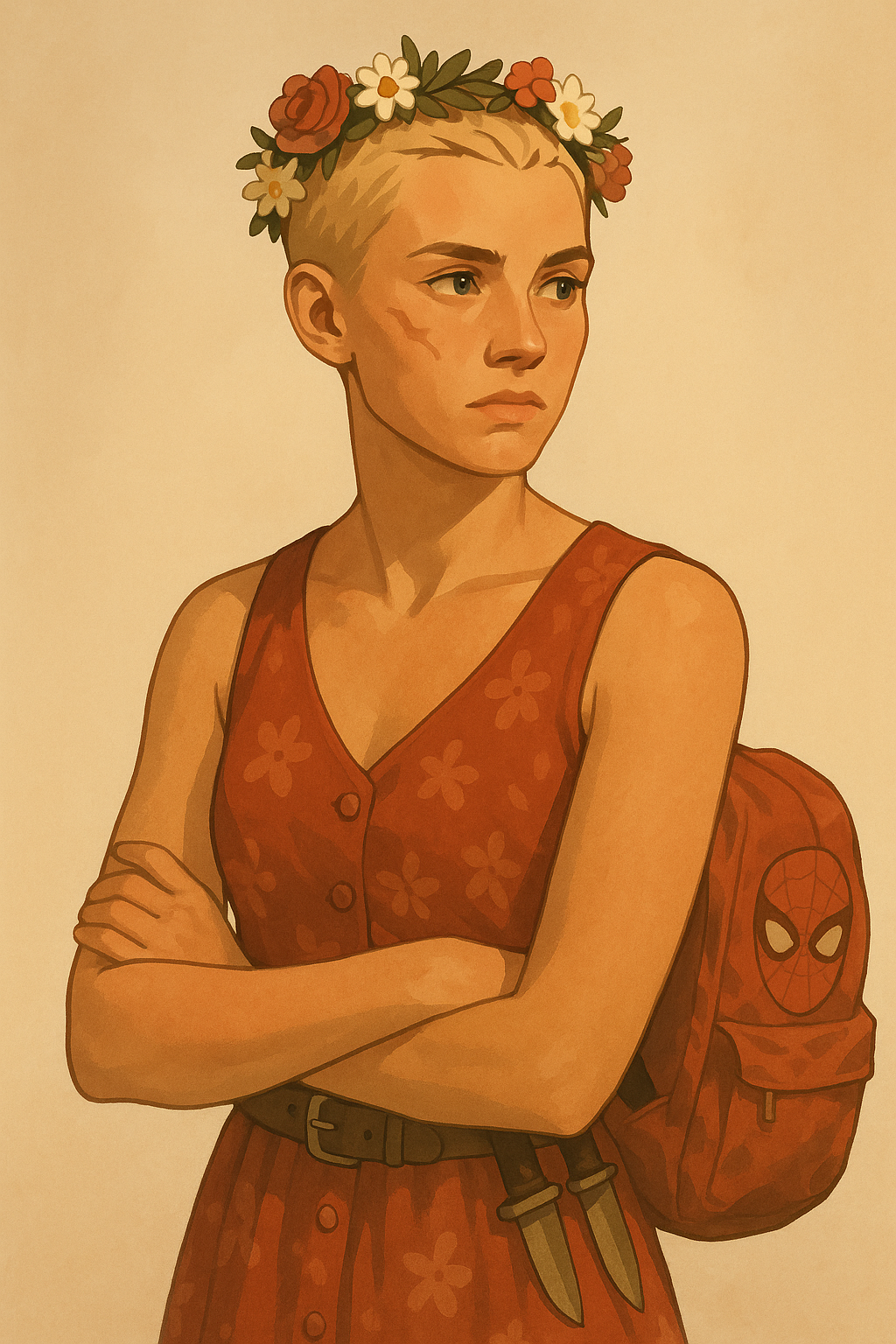
Twenty years after the Georgia Flu, adult Kirsten Raymonde is an actor in the Traveling Symphony, a troupe of musicians and Shakespeare performers who move between settlements.
Painted on their lead caravan is their motto:
“Because survival is insufficient.”
Kirsten:
- carries two knives
- has two tattoos (one for each man she killed in self-defense)
- obsessively collects old tabloid magazines mentioning Arthur
- still owns the two Station Eleven comics Arthur once gave her
The Symphony performs Shakespeare plays and classical music — even orchestral arrangements of old pop songs — keeping art alive long after technology disappears.
St. Deborah by the Water — and the Prophet
When the Symphony revisits the town of St. Deborah by the Water, they find it completely changed.
A charismatic, unsettling leader known as the Prophet controls the settlement. He claims the pandemic was a divine cleansing — that the survivors were chosen.
He demands the Symphony leave behind their youngest actress, Alexandra, to be his next bride. They refuse and leave immediately.
Soon after, two members — Dieter and Sayid — disappear. They have been kidnapped by the Prophet’s men.
Kirsten & August Learn the Truth
Separated from the main group, Kirsten and her closest friend, August, meet people who warn them:
- The Prophet is heading toward the Museum of Civilization
- He uses a symbol resembling an inverted airplane
- He is dangerous
Sayid later escapes, reporting that Dieter was killed.
Kirsten, August, and Sayid travel north, hoping to reach the airport settlement.
The Prophet Revealed
On the road, the group is intercepted by the Prophet and his followers.
Kirsten kills one of his men in self-defense — her third kill.
The Prophet confronts her directly.
He quotes lines from Station Eleven, the comic she carries.
And then Kirsten sees it:
A page from Station Eleven — folded carefully — in his pocket.
The Prophet is Tyler Leander, Arthur’s son.
He grew up in the post-pandemic world surrounded by Elizabeth’s mystical beliefs and developed his own violent, prophetic doctrine.
As he raises his gun to kill Kirsten, one of his young followers — a boy the Prophet has groomed — shoots Tyler instead, saying “We are the light.”
The boy immediately kills himself afterward.
Kirsten places the comic page back in the Prophet’s hand.
III. Severn City Airport — The Museum of Civilization
Kirsten, August, and Sayid finally reach Severn City Airport, where Clark Thompson and the remaining airport survivors still live.
Clark gives them a tour of the Museum of Civilization and recognizes Kirsten from a photo of child-Kirsten with Arthur Leander.
He also recognizes the Prophet’s inverted-airplane symbol — confirming that Tyler’s cult had been born from the airport community years ago.
A Glimmer of Hope
In the air traffic control tower, Clark shows Kirsten a telescope.
She scans the horizon and sees something impossible in a world without power:
Electric lights.
A town somewhere has working electricity.
The Symphony chooses to leave shortly afterward, heading toward those lights — toward hope, toward a rebuilding world, toward the possibility of a new civilization rising from the ruins.
IV. Jeevan’s New Life
Fifteen years after the collapse, Jeevan lives in a peaceful settlement called McKinley (formerly in Virginia). He has become the community’s de facto doctor, despite never finishing formal training.
He is married to Daria, and they have a young son named Frank, honoring his brother.
Jeevan rarely thinks about his old life. He has found purpose.
He hears rumors of the Prophet’s violence but chooses not to travel north — he has responsibilities, and his life is no longer defined by the past.
Ending
The book closes with the Traveling Symphony heading toward the distant, electrically lit town — carrying their art, their music, and their belief that survival alone is never enough.
Humanity is beginning again.
🔚 Ending Explained
Station Eleven Ending Explained
The ending of Station Eleven brings the novel’s scattered timelines and character arcs together in a moment of clarity, closure, and quiet hope. After years of chaos, violence, and survival, the final chapters suggest that the world is not only stabilizing — it’s beginning to reawaken.
🔥 The Prophet’s Death — The End of a Threat
The story’s central conflict resolves near the Severn City Airport when Kirsten, August, and the injured Sayid finally confront the Prophet (Tyler Leander) and his followers.
- Kirsten and Tyler speak using lines from the Station Eleven comics, revealing how deeply he has interpreted them as scripture.
- Their exchange draws a symbolic contrast:
- Tyler identifies with Dr. Eleven’s fatalistic, chosen-ones worldview.
- Kirsten quotes the Undersea, the characters who long for the past and reject Tyler’s ideology.
- Before Tyler can kill Kirsten, one of his own young followers shoots him, then kills himself.
This moment delivers the novel’s version of poetic justice:
Tyler’s deterministic belief system — that everything is preordained — is destroyed by the free will of a child he manipulated. It proves that people can break from indoctrination and choose their own actions, even in the new world.
With the Prophet gone, the Symphony’s path forward becomes clear.
🏛️ The Museum of Civilization — Memory as Survival
Kirsten, August, and Sayid reach the Severn City Airport, now a thriving settlement curated by Clark Thompson. His Museum of Civilization is more than a collection of relics — it is a preservation of:
- memory
- history
- identity
- the emotional weight of the world that was lost
Inside the museum:
- Kirsten donates one of her cherished Station Eleven
- Clark recognizes scenes within the comic that mirror Arthur and Miranda’s life, highlighting how interconnected these characters always were.
- The narrative briefly returns to Arthur’s final moments, showing his regrets, his promises, and the lingering sense that he never fully lived the life he wanted.
The museum becomes a reminder that civilization is not technology — it is memory, art, and connection.
🌅 Reawakening — Signs of a New World
Up in the air traffic control tower, Clark shows Kirsten something impossible:
➡️ A town to the south with electricity.
It is the first working electrical grid they have seen in twenty years.
This moment shifts the tone of the entire novel. After decades of stasis, isolation, and survival, there is now evidence that humans are beginning to rebuild the world rather than simply endure it.
Clark imagines:
- streetlights
- symphonies
- newspapers
- progress on the horizon
The Symphony pauses at the airport for five weeks, then chooses to continue their journey south toward the lights — toward rebirth, toward possibility, toward a future that feels larger than survival.
Their motto, “Because survival is insufficient,” finally takes physical shape.
🫶 Jeevan’s Peaceful New Life
The ending also confirms the fate of Jeevan Chaudhary, who has long been separated from the other characters:
- He now lives in a peaceful settlement in former Virginia.
- He is married to Daria.
- They have a son named Frank, honoring Jeevan’s brother.
- He serves as the settlement’s medic — the role he had always been searching for.
Jeevan rarely thinks about his old life.
The world ended, and he found purpose within what came after.
✨ What It All Means
The ending of Station Eleven suggests that although the old world died — symbolized by Arthur’s onstage collapse — the essential parts of humanity didn’t:
- Art survived (the Symphony, the comics).
- Memory survived (the Museum).
- Connection survived (Kirsten, Clark, Jeevan, the Symphony).
- Choice survived (the boy who defied Tyler).
And now, finally:
Civilization may be returning.
The electric lights in the distance are a promise — that humanity is moving again, slowly and quietly, toward something like a future.
👤 Characters & Fates
🔶 Main Characters



🔷 Supporting Characters
🕳️ Potential Plot Holes
A key plot point involves the Prophet’s men using a chloroform-like substance to incapacitate Symphony members—twenty years after the collapse.
●The Issue: Most medical-grade chemicals degrade significantly over time. Earlier in the novel, we’re told that pharmaceuticals disappeared almost immediately after the pandemic. So where is this still-potent substance coming from two decades later?
●What the Book Suggests: The narrative quietly hedges. Sayid questions whether it’s actually chloroform, noting it may be “something much more toxic”—especially since Dieter never wakes up.
👉 Translation: This might not be a plot hole so much as a vague workaround… but it definitely raises an eyebrow.
The Georgia Flu kills incredibly fast—symptoms within hours, death within 24–48 hours.
●The Issue: In real-world epidemiology, viruses that kill this quickly usually burn out before spreading globally. Hosts die before they can infect enough people.
●What the Book Suggests: The novel explains this through international air travel, with planes full of infected passengers leaving Moscow before anyone understood what was happening.
👉 It’s framed as a near-perfect extinction event—but scientifically, it’s right on the edge of plausibility.
There’s a moment where a pilot attempts a flight roughly two weeks after the collapse.
●The Issue: Even if aviation fuel lasts longer than regular gasoline, a successful takeoff in winter conditions—without ground crews, de-icing equipment, or maintenance—is… ambitious.
●What the Book Suggests: The pilot openly admits it’s a gamble, relying on briefly improved weather conditions.
👉 This one isn’t impossible—but it leans heavily on luck and timing.
Kirsten and Charlie find a child’s tea set arranged with unnatural precision in an otherwise destroyed house.
●The Issue: No dust. No footprints. No logical explanation.
●What the Book Suggests: Nothing definitive. The characters themselves question whether it’s supernatural—and then move on.
👉 This isn’t a plot hole so much as an intentional eerie moment… but it does feel like the book briefly steps outside its grounded tone.
Nearly every major character—Kirsten, Jeevan, Miranda, Clark, Tyler—traces back to Arthur Leander.
●The Issue: The odds of multiple key survivors, all tied to the same man, ending up in overlapping regions (and connected through the same rare comic) feel incredibly slim.
●What the Book Suggests: This is entirely intentional. Arthur functions as the narrative anchor, not a realistic coincidence.
👉 Less a plot hole, more a “this is how the story works”—but it can feel a little too neat.
Electricity, the internet, and infrastructure collapse within about a week.
●The Issue: In reality, some systems—especially power grids—might last longer with automated processes and minimal staffing.
●What the Book Suggests: Jeevan reflects that modern life only seems automated—it actually depends on a vast, fragile network of people. Once they stop showing up, everything unravels quickly.
👉 This is one of the more convincing explanations—but still something readers question.
📚 Book Club Q&A's
⭐ Final Rating & Thoughts
Station Eleven delivers a quiet, melancholy apocalypse that’s more about memory, art, and emotional aftershocks than the actual collapse of civilization. The storylines eventually connect — Arthur’s death onstage, Kirsten’s survival, Jeevan’s transformation, and Tyler growing into the Prophet — but the reveals land softly rather than dramatically.
The Prophet twist (Arthur’s son Tyler), the Museum of Civilization, and the Traveling Symphony are the strongest elements, yet the novel maintains a low, reflective heartbeat instead of escalating tension. The ending — with the Symphony seeing electric lights on the horizon — offers a hopeful spark, but not a thrilling one.
Beautifully written, thematically rich, but emotionally muted. A thoughtful, atmospheric read rather than a gripping one.
✨ Adaptation description
The 2021 HBO Max limited series adaptation of Station Eleven, created by Patrick Somerville, stays true to the novel’s emotional core but shifts major plotlines, relationships, and character arcs. The result is a re-imagining rather than a direct translation — softer in tone, more interconnected, and significantly more character-driven.
Major Changes From the Novel
A Deeper Kirsten & Jeevan Relationship
The most notable departure: the show turns Kirsten and Jeevan into a central emotional duo.
- In the book, they meet briefly the night Arthur dies.
- In the show, Jeevan becomes Kirsten’s caretaker.
- Their bond spans months and becomes the heart of the narrative.
This adds emotional warmth that’s not present in the book’s more detached structure.
A Softer, Redeemed Tyler (The Prophet)
The novel’s Prophet is a dangerous, violent cult leader.
The show reframes him with far more empathy:
- Tyler is traumatized rather than purely extremist.
- He receives a redemptive arc, which significantly alters the story’s tone.
- His actions and worldview are portrayed as the product of childhood trauma rather than malevolent ideology.
This shift makes the adaptation more hopeful and less threatening.
Setting Change: Canada → The United States
Mandel’s novel is rooted in Toronto and the surrounding Canadian landscape.
Somerville moves the setting to Chicago and the American Midwest — aligning it with his own background.
Ironically, due to COVID production shutdowns, filming moved to Mississauga, Ontario, right outside Toronto.
So the Canadian setting disappears in the script… only to reappear behind the camera.
A More Linear, Relationship-Focused Narrative
The show streamlines the book’s nonlinear structure:
- Characters’ timelines are woven together more tightly.
- Emotional connections are emphasized over thematic ones.
- Several side characters receive expanded arcs.
The adaptation feels more like an ensemble drama than a fragmented literary mosaic.
Expanded Roles for Key Characters
Jeevan, Kirsten, Tyler, and Frank all receive deeper backstories, additional scenes, and more emotional development.
Minor book characters are reimagined or elevated to major roles.
Overall Tone of the Series
The HBO version is:
Warmer • Lusher • More Emotional • More Hopeful • Visually Rich • Relationship-Centered
Where the novel is quiet and melancholy, the series leans into:
- found family
- forgiveness
- connection
- the healing power of art
Both versions honor the famous line “Survival is insufficient,” but the adaptation interprets it through a more optimistic lens.
✨ Books Like Station Eleven
See an error on this page?